The V WebAssembly Compiler Backend
Intro Overview.
Thanks to me, V can compile to WebAssembly natively!
What does this mean for V?
A lot of things, actually.
- V can compile and run on the web unhindered. This means game engines, graphics, expensive computation.
- V has access to a large array of performant sandboxed native runtimes implementing the WASI standard.
- It just works!
Try it!
When you see this, the pull request #17368
would have hopefully been merged.
Install
libbinaryen.so/dll- Package manager.
pacman -S binaryen/emscripten, pkgbinaryenas a guide - All else fails + Windows? Build From Source
- Package manager.
(UPDATE) V can assist you in installing Binaryen using Binaryen’s Github releases.
Just run
v -b wasm file.vand follow it’s instructions!
- Write some V code
$ v up # Update V
$ cat << EOF > test.v
fn adder(x int, y int) int {
    return x + y
}

fn main() {
    println(adder(10, 15))
}
EOF
$ v -b wasm test.v # Compile to `test.wasm`
$ wasmer test.wasm # WebAssembly runtime of choice
25- Check out some examples inside
examples/wasm
The mandelbrot example inside examples/wasm/mandelbrot
functions suprisingly well.
It uses the experimental browser mode, instead of WASI.
v -b wasm -os browser mandelbrot.v
Alex even tweeted about it during early development!
Current State And Details.
The WebAssembly compiler backend for V implements
two different modes, wasi and
browser.
v -b wasm -os wasiv -b wasm -os browser
The default mode of compilation is
wasi, the WebAssembly System Interface.
The wasi spec implements many WebAssembly
“system calls”. It will be comparable to a native
program. The entirely of libc will be implemented, and
a program compiled with wasi will be equal
to a program compiled with cgen.
The browser target will be a full
WebAssembly framework, like Emscripten. declare
JavaScript functions inside V, access the DOM and
canvas. It will also generate JS files and optionally
HTML. v run should start up a web server
and open a webpage to invoke your WebAssembly code,
like emrun from Emscripten.
Development on the wasi target will be my core goal. Since code can be run locally without a JavaScript or browser dependency it’s easier to iterate and test on.
The current browser mode is a stub
implementation while a proper runtime JS libary will be
implemented.
Read the pull request #17368
for more details.
To follow development closely go to the
#wasm-backend channel on the V discord server! I
am quite active there and will consistently post
updates when they come.
Where It All Started.
I looked into WebAssembly. It had insane potential.
As I understood it…
- A low level, universal bytecode format? (That is also not Java)
- Targetable by other programming languages?
- Integrates and runs on the web with ease?
- Can run natively with WASI?
- Secure and sandboxed with speed?
- Standardised?
- Large community?
… I was surprised.
There is a lot of things I could say about WebAssembly. Good things.
So, I started searching on how I could get started.
Binaryen
Binaryen is a compiler and toolchain infrastructure library for WebAssembly, written in C++. It aims to make compiling to WebAssembly easy, fast, and effective.
Think of it like an alternative to LLVM, but for WebAssembly only.
The C API can be used to build up an expression tree, and it’s IR maps pretty closely to WebAssembly.
Take this C code…
BinaryenModuleRef module = BinaryenModuleCreate();

BinaryenType ii[2] = {BinaryenTypeInt32(), BinaryenTypeInt32()}
BinaryenType params = BinaryenTypeCreate(ii, 2);
BinaryenType results = BinaryenTypeInt32();

BinaryenFunctionRef function =
    BinaryenAddFunction(module, "adder", params, results, NULL, 0,
        BinaryenBinary(module, BinaryenAddInt32(),
        BinaryenLocalGet(module, 0, BinaryenTypeInt32()),
        BinaryenLocalGet(module, 1, BinaryenTypeInt32())));

BinaryenModulePrint(module);
… and it’s WebAssembly output.
(module ;; BinaryenModuleRef module = BinaryenModuleCreate();
 (type $i32_i32_=>_i32 (func (param i32 i32) (result i32)))
 ;; BinaryenAddFunction(module, "adder", params, results, NULL, 0,
 (func $adder (param $0 i32) (param $1 i32) (result i32)
  ;; BinaryenBinary(module, BinaryenAddInt32(),
  (i32.add
   ;; BinaryenLocalGet(module, 0, BinaryenTypeInt32())
   (local.get $0)
   ;; BinaryenLocalGet(module, 1, BinaryenTypeInt32())
   (local.get $1)
  )
 )
)- Binaryen has a simple stable C API in a single header, and can also be used from JavaScript.
- Binaryen can be used for completely parallel codegen and optimisation, as it is designed that way.
- Binaryen’s optimiser has many, many optional passes that can improve code size and speed. It applies many agressive optimisations which make Binaryen powerful enough to be used as a compiler backend by itself.
Binaryen V Wrapper
I realised early on that a V wrapper needed to be created.
I created it using c2v, pushed some
changes in the pull request #17125
to allow [c:'cname'] function attributes
inside the compiler without a translated flag. Then, it
could be used perfectly!
At this point, I did not know I wanted to create a V backend utilising Binaryen.
I asked around in the community for what they would prefer in a native WASM backend.
They weren’t too turned off with the idea, a native WebAssembly backend would be pretty welcome.
So, I started work.
Early Beginnings
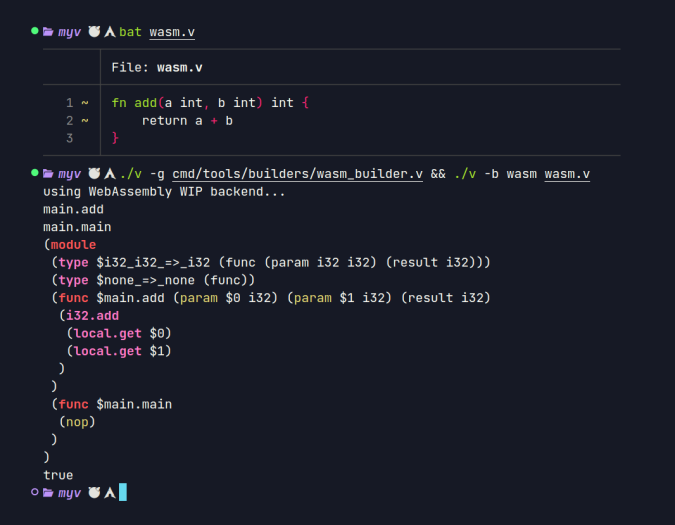
[ l-m ] progress being made on the wasm backend using binaryen
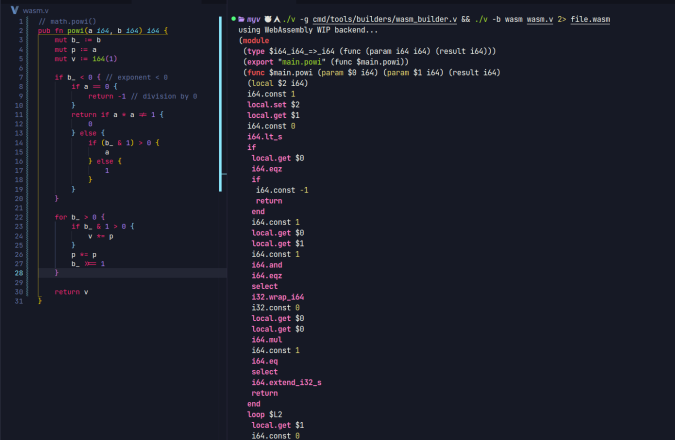
[ l-m ] milestone crushed! compilation and execution of math.powi straight to webassembly
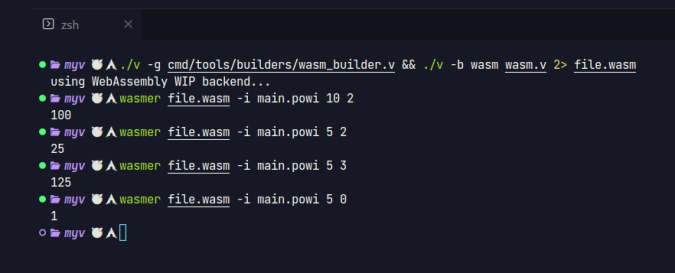
[ l-m ] works like a charm
[ Alex M ] great work @l-m !
pub fn factorial(n i64) i64 {
    if n == 0 {
            return 1
    }
    return n * factorial(n - 1)
}
At this stage the current WebAssembly backend could
only compile simple programs, with no
builtin library.
Simple float and integer arithmetic were supported in it’s entirety.
(func $main.factorial (type $i64_=>_i64)
 (param $0 i64) (result i64)
 local.get $0
 i64.eqz
 if
  i64.const 1
  return
 end
 local.get $0
 i64.const 1
 i64.sub
 call $main.factorial
 local.get $0
 i64.mul
)
Structures, stack allocations, println,
panic, strings?
Not implemented at this point. I was new to backend creation and WebAssembly in general. But the more I explored Binaryen’s C API, the further I got.
This was the point where I realised that focusing my development effort on WASI, instead of a browser target would be a much better use of my time. Better to test and no browser or JavaScript dependency.
WASI support
If WASM+WASI existed in 2008, we wouldn’t have needed to created Docker. That’s how important it is. Webassembly on the server is the future of computing. A standardized system interface was the missing link. Let’s hope WASI is up to the task!
>>>> Solomon Hykes, founder of Docker.
Completely containerised sandboxed applications running at native speed, that’s Docker.
But that’s also WebAssembly.
WASI, The WebAssembly System Interface, is a modular system interface for WebAssembly. Think of them as a standardised list of “system calls”, an API, providing native POSIX-like functionality for WebAssembly.
Want to write to stdout?
Simple, on POSIX like kernels (Linux, Unix, BSD…)
the write system call is used to write to
a file descriptor.
WASI takes a different but also similar approach.
fn C.write(fd int, buf voidptr, count usize) usize

val := "hello"
C.write(1, val.str, val.len)
Each standard of the WASI interface is separated into different import namespaces.
I am importing API functions from the
wasi_snapshot_preview1 namespace. The
WebAssembly runtime will notice this and provide the
needed functionality.
type Errno = u16

struct CIOVec {
    buf &u8
    len usize
}

[wasm_import_namespace: wasi_snapshot_preview1]
fn WASM.fd_write(fd int, iovs &CIOVec, iovs_len usize, retptr &usize) Errno
As always, V function interop has been done with a language prefix.
C.function,JS.function,WASM.function
The function declaration using the WASM
prefix boils down to this WebAssembly below.
(import "wasi_snapshot_preview1" "fd_write" (func $WASM.fd_write (param i32 i32 i32 i32) (result i32)))It can then be called like a normal V function.
The fd_write WASI function takes an
array of I/O vectors containing the data to be
written.
It’s similar to the POSIX writev C
function.
val := "hello"

vec := CIOVec{val.str, usize(val.len)}

WASM.fd_write(1, &vec, 1, -1)
The builtin function println is
implemented this way, with an array of two stack
allocated I/O vectors.
One vector storing the data to be written, another with the newline. It’s a much nicer implementation compared to the C version, in which an entirely new string needs to be allocated containing the string and newline.
fd_write with N amount of I/O vectors
results in only one write system call, which is
perfect.
module builtin

pub fn println(s string) {
    elm := [CIOVec{
        buf: s.str
        len: usize(s.len)
    }, CIOVec{
        buf: c'\n'
        len: 1
    }]!

    WASM.fd_write(1, &elm[0], 2, -1)
}
What Is And Isn’t Possible?
The WebAssembly backend is NEW, very very new.
I am a one man team and I assume will be the lead on most future updates.
I’ll get a couple things out of the way.
These built in constructs to the V programming language are not supported yet.
- Interfaces
- Sum Types
- Generics
- Dynamic Arrays
- Maps
- String Interpolation
- Auto String Methods For User Types
These are.
- Methods
- Aliases
- Structures
- Fixed Arrays
- Strings
- Integers And Booleans To Strings
printandpanic- Dummy
mallocimplementation
Hey, that’s not too bad?
Plus, things such as dynamic arrays, string interpolation and maps can be easily implemented with just a little time. The infrastructure to implement these features is already in place.
I would say, this backend is comparable if
not exceeds the capabilities of the current
native backend.
There isn’t much documentation, but that will come soon(ish).
So, give it a go!
I’ll be reading your issues with care, because….
I’m on the team!
I’ve been in the V community and used this language for fun for a while now, so it’s about time i give back.
I guess they liked me enough to put me on there.
I’ll see myself out. Thank you for reading!